

Welcome to today’s daily update for Thursday, August 6, 2026. Here’s everything you need to know.
The Breakdown
Central Europe’s rivers are drying up so quickly that it can be seen from space. Temperatures are breaking records in places that have not yet felt the brutality of global warming’s summer heat. This may be the harsh reality that Europe must face as climate change intensifies.
Searing temperatures have plagued western Europe for much of the summer, with the UK, Spain, and France sweltering in record heat. The occasional temperature rise would see residents crank up the air conditioning – for those who have it – but rain has been noticeably scarce. Now, a heatwave, coupled with extremely dry conditions, has moved into central Europe.
Temperatures have smashed records – yesterday, both Austria and Slovakia recorded their hottest day in history. In southern Slovakia, the town of Kamenica nad Hronom reported an afternoon high temperature of 106.5°F (41.4°C), breaking the previous record of 106.3°F (41.3°C) set by the same town last week. Nightfall has not brought any relief; the low temperature coming into Wednesday morning was a staggering 83°F (28.4°C), breaking yet another record.
In Austria, the eastern border town of Bad Deutsch-Altenburg reported a record-breaking high of 106.1°F (41.2°C), beating the previous record of 105.8°F (41°C) – set just the previous day.
Unfortunately, the situation is not expected to improve. Temperatures are expected to experience a brief and minor cool-off in the next few days before re-intensifying next week, soaring back into the 100s (38-41°C).
Meanwhile, the region’s rivers are running dry. Hungary has been forced to completely shut down the nation’s only nuclear power plant, and Romania has suspended operations at one of the two nuclear reactors at the Cernavodă Nuclear Power Plant. Along the border of Romania and Bulgaria, authorities were forced to use explosives to force tiny amounts of water towards the cooling pipes for the Cernavodă plant, helping keep it online.
Nuclear plants require large amounts of water for cooling purposes, and the water levels of the Danube River are simply too low to continue operations.
In fact, the Danube is now reaching such extreme levels that World War II-era German battleships are coming into view, lying on the bottom of the riverbed. Many are still equipped with weapons after Nazi Germany deliberately sank their Black Sea fleet to evade the Soviets.
Large ships are no longer able to traverse the river, and small boats must evade emerging sandbars, rocks, and dunes that litter the surface of the water. In Budapest, water levels have shattered previous records, dropping as low as four inches in some spots. A similar situation has occurred on other major rivers, like the Rhine, where cargo ships have been forced to reduce loads by as much as 80% to avoid running aground.
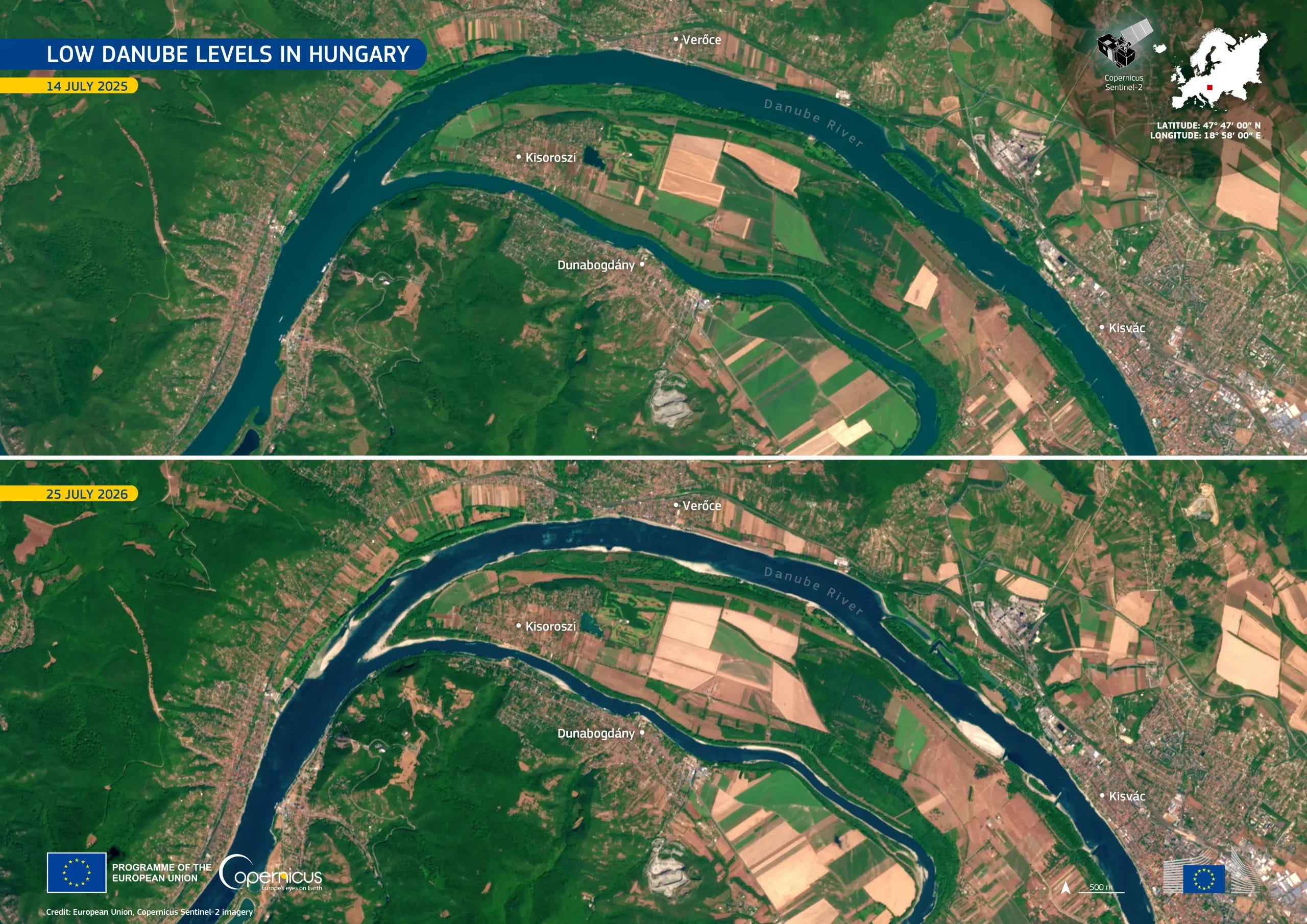
The devastation can even be seen from space. New images from the European Space Agency’s Copernicus Sentinel-2 satellites revealed banks of sand along the edges of the Danube, with major drops in water levels – in some areas, instead of one thick blue band, the images show thin streaks of water between mountains of sand.
The Global Snapshot
German officials have expressed serious alarm after a drone carrying explosives was successfully neutralized at the nation’s Leipzig airport. Several flights were diverted as authorities handled the threat, using a bomb disposal robot to disable the explosives. Police confirmed that the bomb was intricately crafted and surely the work of an expert, raising concerns that a foreign power could be involved in the attempted attack – and if their suspicions are true, could there be more attacks on the way? Several have placed the blame on Russia, but investigations are still underway.
The Pacific island nation of Nauru, the third-smallest country in the world, has officially changed their name to Naoero. According to the government, the nation had changed its name to Nauru to avoid mispronunciation by foreigners, but they intend to change that. The new name reflects its pronunciation in their native language, serving as a symbol of restoring the island’s cultural and national heritage during a time where they are struggling with climate change and rising sea levels.
Fact of the Day (The Fact Site): There are 7 to 30 times more trees on Earth than there are stars in the Milky Way. It’s estimated that there are between 100 billion and 400 billion stars in our galaxy, compared to around 3 trillion trees on our planet. However, that number is rapidly decreasing – scientists estimate that the figure was closer to 6 trillion before human civilization took hold of the Earth.
Quote of the Day (Gracious Quotes): Tomorrow belongs to those of us who conceive of it as belonging to everyone; who lend the best of ourselves to it, and with joy. (Audre Lorde)
Word of the Day (Merriam-Webster): Colloquial (adj, kuh-LOH-kwee-ul) - Colloquial is used with words like term and word and expression to describe language that is used in familiar and informal conversation.
In a Sentence: The author can switch from formal academic language to a charmingly colloquial style, depending on the audience and subject of her writing.
Image: Rawpixel / Public Domain
Enjoyed this breakdown? Subscribe to help support our publication!