

Over the years, SpaceX has become a household name in both the United States and around the world, pioneering new ways to revolutionize telecommunications, reach the Moon, and even launch spacecraft into the depths of the universe.
Let’s dive into SpaceX itself, today’s IPO, what investors were expecting, and how markets actually moved.
If you’re not an expert in finance, don’t worry about it. Your money matters too. We’ve covered all the basics, so you can engage with markets without the hassle.
Note that this article is not financial advice – at Your News Hub, we’re focused on giving you all of the information so you can make a decision. Instead of sending you searching across hundreds of paywall-blocked articles, we’ve summarized everything you need to know, complete with definitions, facts, statistics, and graphs.
Introduction | History | The Three Divisions | The Lead-Up | Why Investors Were Bullish | Why Investors Were Skeptical | How the Market Moved | What This Means For Musk | What This Means For SpaceX
Reading Time: 11 minutes. Grab a coffee – we’re breaking down everything you need to know about today’s historic SpaceX debut.
Introduction
In this article, we’ll be covering:
The history of SpaceX
The company’s corporate structure and how it influences investor sentiments
The lead-up to the IPO, including investor predictions
How markets actually moved
How this benefits SpaceX founder and CEO Elon Musk
What this means for the corporation as a whole
Here are some key terms you might want to know before we dive in. If you’re already experienced in the finance sector, you can go ahead and skip over these explanations.
An IPO, or initial public offering, is where a private corporation begins selling shares to the public.
This process allows companies to raise capital for future operations, pay off debt, and increase liquidity, allowing founders and earlier investors to sell their shares on the public market.
Market capitalization is a term used to describe the total value of a company’s outstanding shares available on the market.
This value is typically calculated by multiplying a company’s share price by the total number of shares.
A company’s P/S ratio, or price-to-sales (also known as price-to-revenue) ratio, is the ratio of their total market capitalization divided by their revenue across the last twelve months.
A lower P/S indicates undervaluation, meaning that the stock is a stronger buy, while higher P/S ratios typically indicate overvaluation.
However, companies with high P/S ratios can still be strong candidate stocks for investors.
History
Founded in 2002 by now-trillionaire (yes, trillionaire – keep reading for more) Elon Musk, the company has quickly become NASA’s go-to source for mission planning and space innovation.
In 2015, SpaceX landed the first-stage booster of the Falcon 9 rocket back onto a launchpad at Florida’s Cape Canaveral, establishing that rockets could now be reused – a feat that has only been achieved by a handful of companies to this day.
In 2019, SpaceX’s Falcon 9 rockets launched their first Starlink satellites into space, revolutionizing the telecommunications industry. Today, Starlink Roam can be accessed from even the most remote places on Earth, and it has proved to be a crucial resource for troops fighting in eastern Ukraine against Russia.
Then, in 2023 and 2024, SpaceX began testing Starship, a staggering 407-foot-tall rocket with a payload of over 100 tons. On their fifth test, they successfully caught the monstrous Super Heavy booster in midair, and continued Starship tests in 2026 have achieved additional milestones that are bringing the company closer to a future mission to the Moon or even Mars.
The Three Divisions
In February, SpaceX incorporated Musk’s AI company, xAI, into its corporate structure, creating a company with three essential divisions: telecommunications (Starlink), space exploration (SpaceX), and artificial intelligence (xAI).
Starlink, the telecommunications division, is where most of the company’s profit comes from, making up 61% of SpaceX’s total revenue in 2025. With an EBITDA margin of 63% and over 10.3 million subscribers across more than 160 countries, the satellite internet platform is incredibly lucrative and serves as the corporation’s only profitable division.
Meanwhile, their space exploration programs have received substantial government funding, but additional investments into new innovations and upcoming missions across the last few years have led to significant losses – in 2025, the division reported a net loss of $635 million.
Finally, the artificial intelligence portion of the company is currently the most unprofitable of the three, resulting in a $6.35 billion deficit in 2025. xAI has invested heavily into new infrastructure over the last few years, including massive data centers to support their latest supercomputer, Colossus.
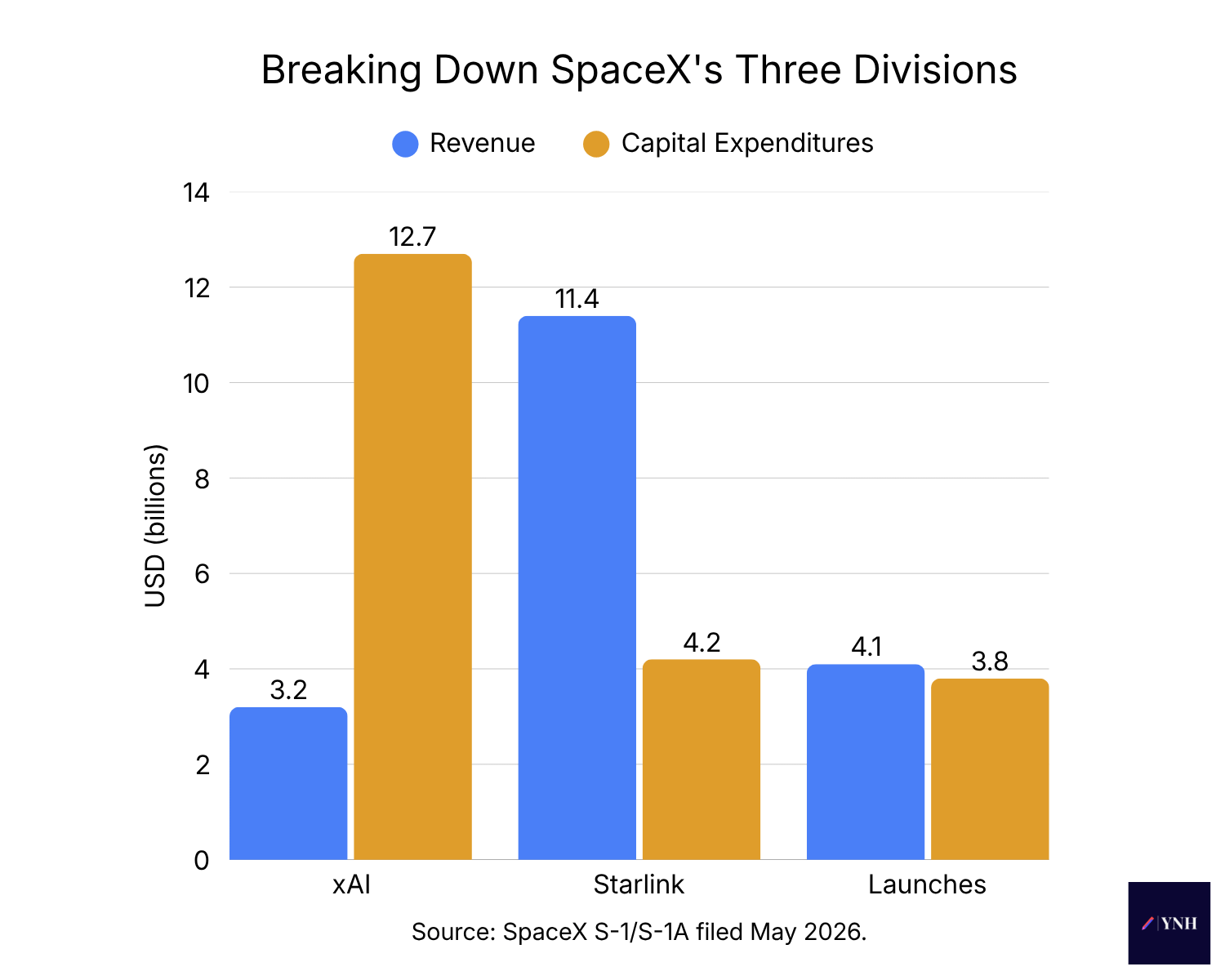
According to SpaceX’s pre-IPO S-1 filing, xAI accounted for just 17% of the company’s revenue while eating up 61% of capital expenditures. The division has also failed to gain traction against the battle for market share against other corporations like OpenAI, Alphabet, and Anthropic, leading to the aforementioned losses.
However, investors have pointed out that the leasing of the company’s infrastructure capabilities could become a highly profitable sector of the business in the near future. Just last month, xAI secured a major deal with Anthropic to lease the entire Colossus 1 supercomputer – including over 200,000 Nvidia graphics processing units – to assist in the training of Claude, garnering them around $1.25 billion per month.
The Lead-Up
An initial public offering, or IPO, requires a filing in advance by the company, who must disclose various statistics ahead of time to inform investors of its potential. Then, the day before the official IPO, the allocated shares are pre-sold to accredited investors – usually large banks and financial institutions – who sell those shares on the day of the IPO.
Following months of pitches to major sovereign wealth funds and prominent investors, SpaceX had settled on a final price-per-share of $135, setting their target valuation at $1.77 trillion – that figure would have made them the sixth-largest company by market capitalization in the world. Large corporations typically target a price range, rather than releasing a specific share price ahead of the public offering. This led to significant deliberation over the company’s true valuation, which intensified after the market response proved to be even bigger than SpaceX expected.
Beginning today, investors would be able to purchase the new stock under the ticker SPCX. Yesterday, as part of their pre-IPO sales, SpaceX allocated around 30% of their total ownership to retail – a relatively high percentage for a public offering, given that most companies just put up around 10-20% of their total equity for individual investors.
The remaining 70% was sold to the aforementioned accredited investors, as is traditional the day before an IPO.
At a price of $135 per share, SpaceX pre-sold all 555.6 million shares for a total of $75 billion – shares that hit the public market today. However, investor reports indicated that the market was willing to pay as much as $250 billion for the shares, led by major institutions like BlackRock – the asset manager alone accounted for the sale of over $5 billion in shares.
ARK, an investment management firm, believes that the company could reach a $2.5 trillion valuation by 2030.
Not all investors were convinced, though.
Prior to the IPO, Morningstar, a global private equity and venture capital firm based out of Hong Kong, valued SpaceX at just $780 billion – less than half of their projected valuation.
Why Investors Were Bullish
Many investors remained bullish on the stock, leading to heavy oversubscription ahead of the IPO; unlike other corporations, which typically have a ceiling on projected growth, there is no way to probabilistically determine the future growth of SpaceX. The company, essentially, has limitless upside, with projects like Starlink and Starship making progress alongside a host of upcoming government contracts with NASA. Space is an uncharted, boundless market, and demand for space exploration will not stop anytime in the near future.
Reports show that SpaceX launches are responsible for the deployment of around 85% of all active satellites, and launch costs themselves have decreased more than 95% since 2008.
According to SpaceX’s pre-IPO S-1 filing, the company reported around $6.58 billion in adjusted EBITDA in 2025 against a total revenue of $18.67 billion, solidifying high EBITDA margins of around 35% – the traditional aerospace or hardware company maintains EBITDA margins of just 15-20%. This indicates that the company is highly efficient at converting revenue into profit – courtesy of Starlink.
Earnings before interest, taxes, depreciation, and amortization is known as EBITDA.
This is calculated by adding the aforementioned four values to a company’s total profits, providing a value that is widely used to measure a corporation’s profitability and financial performance.
EBITDA margins indicate how efficient a company is at converting revenue into profit, with higher margins indicating more efficiency.
Then, they looked at the company’s total enterprise value to increase accuracy. According to Morningstar, at the end of the first quarter of 2026, SpaceX had around $16 billion in cash and $30 billion in debt, with the majority of that debt coming from recent investments in data centers within the AI division. Factoring in the $75 billion cash inflow from the IPO, the corporation’s total enterprise value – one of the truest measures of a company’s value – comes out to around $1.71 trillion.
Combining these two statistics results in an EV/EBITDA – used to compare current profitability and the company’s total value – of approximately 260x. The average ratio is between 8x and 30x. This means that current investors are relying heavily on forward P/S and future revenue streams, with some projections showing that SpaceX could achieve massive profitability as soon as 2028 or 2029.
However, it can also signal that a stock is extremely overvalued or is facing a critical bubble. According to Fortune, realistically justifying their $1.77 trillion valuation would require the company’s revenue to skyrocket to over $1.1 trillion in 2035 – an average growth rate of 50% year-over-year, which has never been achieved by any company in history.
Putting that into perspective, $1.1 trillion in revenue would be approximately 2.4% of the US GDP in 2035.
Why Investors Were Skeptical
Despite their high EBITDA margins and $18.67 billion in 2025 revenue, SpaceX reported a net loss of $4.9 billion on the year due to heavy investments into R&D and innovation.
Additionally, at SpaceX’s projected valuation of $1.77 trillion, the company would have an astronomical P/S ratio of 95x. The average P/S ratio for public companies is between 1x and 4x, with large tech or artificial intelligence corporations leaning closer to 10-20x. For example, Alphabet has a P/S ratio of around 10.8x, while Nvidia’s is approximately 19.3x.
Most skeptics expressed concerns about the company’s valuation being artificially inflated by their self-imposed restriction on available equity. Data shows that SpaceX sold just 5% of equity to investors via Class A shares during today’s public offering – an incredibly small value for a company with such a staggering valuation. Other corporations, like Alphabet and Nvidia, have put up close to 100% of their total equity to be publicly traded, allowing investors’ voting power to directly match financial investment.
Different corporations can choose to vary the power given via each stock through classes. Nvidia has no classes, meaning that every share receives equal voting power.
At SpaceX, Class A shares – those that are currently publicly traded – receive one vote per share. Class B, on the other hand, are more powerful, receiving ten votes per share.
According to the S-1 filing, Elon Musk owns 5.57 billion Class B shares – around 93.6% of the total Class B shares available – alongside 849.5 million Class A shares. This gives him around 82% of the company’s total voting power, guaranteeing that he remains in control at all times. He can never be ousted as CEO, and he makes all final company decisions rather than a board of directors.
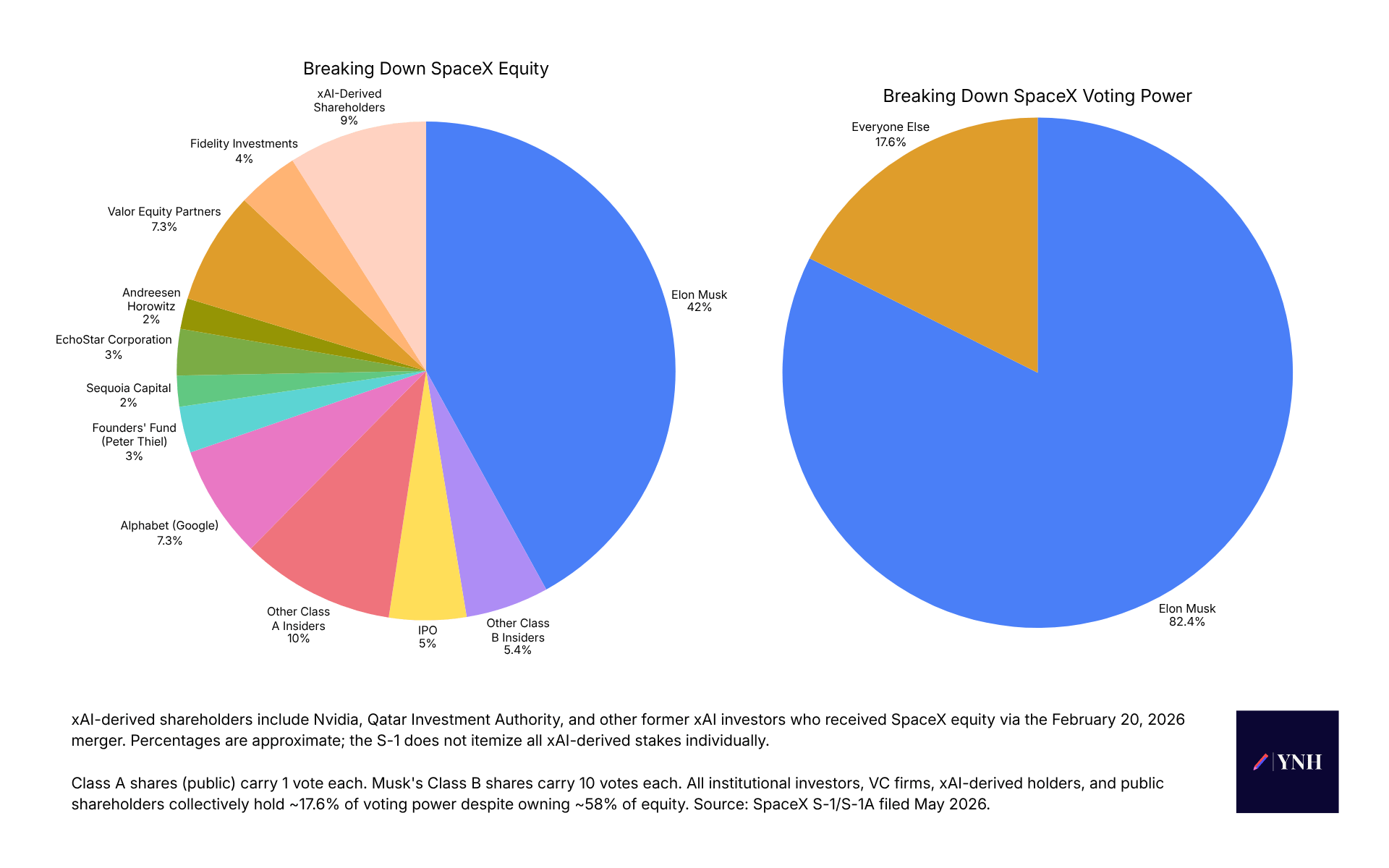
With just 5% of total equity up for sale, SpaceX is at a high risk of triggering extreme volatility, which could send the stock soaring or plummeting with the smallest shift in investor sentiment.
These factors, combined with the dangerous signals of the company’s sky-high EV/EBITDA, put off many experienced investors, who warned that the bubble was bound to burst.
How Markets Moved
Yes, it’s what you’ve been waiting for. What actually happened? How did markets move?
As expected, the first day of trading for SpaceX was a massive success. Due to heavy oversubscription – over four times the actual number of shares available – SPCX had already risen to $150 a share before it even began trading. The stock became available to buy at 10:00 am, and its price soared as high as $176 before cooling during the afternoon.
SpaceX closed out the day with a final price of $160.95 – a 19.22% increase from the initial price of $135 per share. That puts the company’s current valuation at $2.11 trillion.
What This Means For Musk
The success in global markets, along with the company’s unique structure, has made Elon Musk the world’s first-ever trillionaire. Following the IPO, his net worth now stands at approximately $1.05 trillion, with his stake in SpaceX worth around $886 billion.
But, how is this possible?
Musk holds around 82% of voting power with his extensive ownership of Class B shares, corresponding to around 42% of total SpaceX equity. Take 42% of the current SpaceX valuation, add it to Elon Musk’s existing net worth, and there it is. The world’s first trillionaire.
What This Means For SpaceX
Despite the company’s record-breaking IPO, SpaceX is not in the clear. Data shows that major companies tend to suffer from serious dips following blockbuster IPOs.
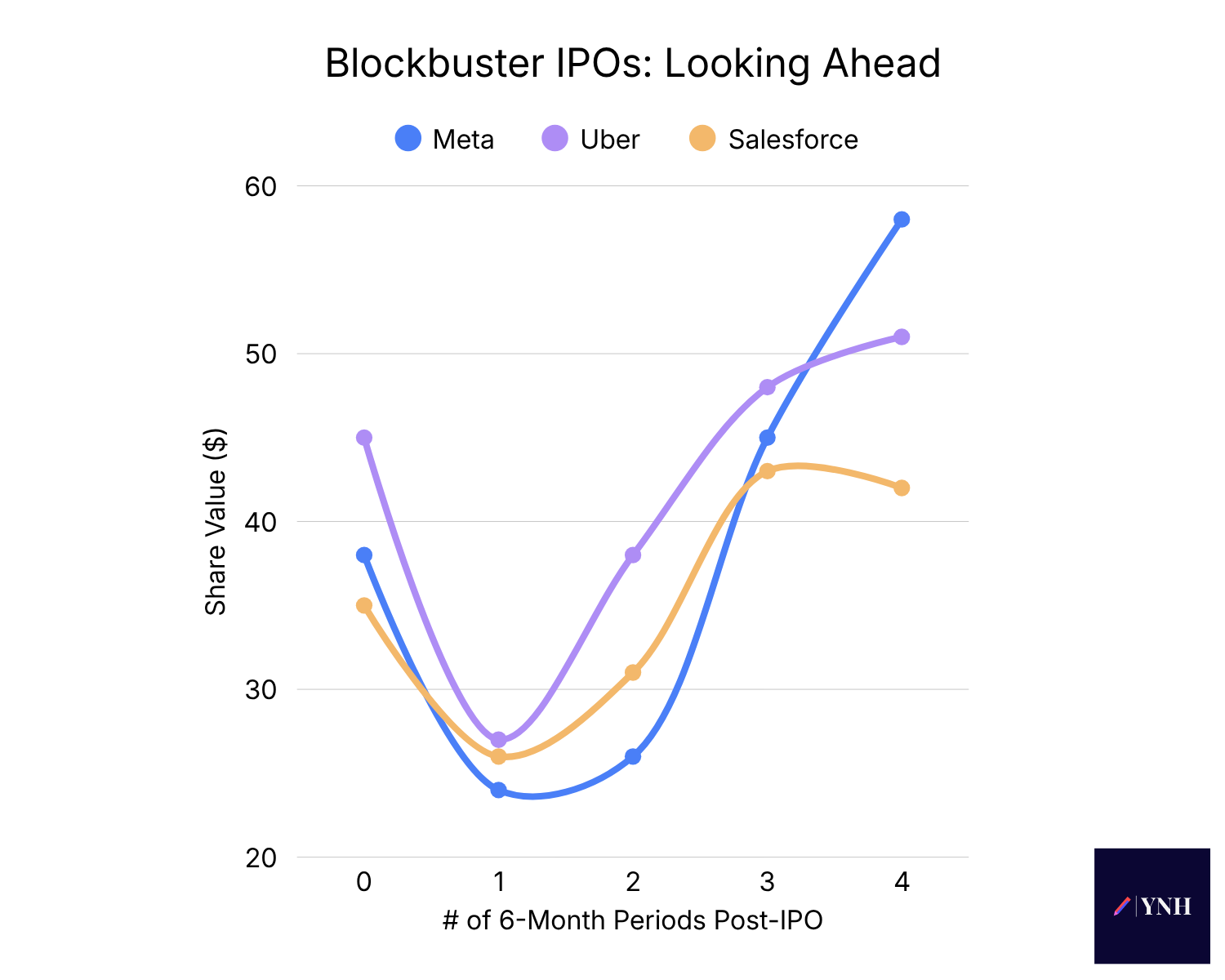
The trend follows a common pattern, with the stock plummeting after an IPO to meet investors’ realistic expectations. Once this number is met, the price begins steadily climbing back up, with high-potential corporations soaring past initial expectations in the long-term.
However, the debate remains whether SpaceX will actually enter that successful period after the projected dip. Long-term investors are counting on the company’s ability to deliver, despite current unprofitability, but others remain reluctant to rely on a company where the statistics are signaling extreme overvaluation.
Either way, it’s up to you, as the investor, to make the decision.
Realistically, do you think SpaceX is a $2.11 trillion bubble bound to burst, or are we looking at the first $5 trillion company by 2035? Leave your thoughts in the comments below.
Enjoyed this deep dive? Hit the like button at the top or bottom of this post so we know to keep breaking down big market events like this one!